
Bio-fuels that can be sustainably produced offer significant greenhouse gas reduction but still require the use of energy and carbon in production.To be produced sustainably they must not replace food production and must not involve clearing forested land.
Bio-fuel feed-stocks that meet these criteria include agricultural waste (example a portion of the shaft in wheat production), forest wastes and new forests and exotic feed-stocks such as algae and Pongamia and Jatropha which can be grown on non-agricultural lands.
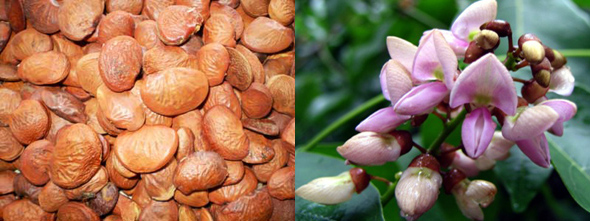
Pongamia is now widely recognized as a superior sustainable crop biofuel species and a logical choice for areas with unpredictable weather extremes as it is hardy across a wide range of conditions. Broad acre ethanol production has had a negative effect on world food prices. Ethanol is not a sustainable or viable solution. Over the long term it may create more problems than it solves. Pongamia plantations on the other hand, have the opposite effect: they regenerate land through building soil and halting erosion, increasing overall crop and stock production.
Pongamia produces significantly more oil than other bio fuel species, up to 8 times the yield of soybeans, and can be grown successfully in much of Australia in temperature ranges from around O degrees Celcius to 50 degrees Celcius and annual rainfall of 250mm to 2500mm.
Pongamia Oil – Yield Estimates
Estimates of 20-40kg of seed per tree per year are expected. Biological plant nutrition, coupled with the implementation of systems which optimise growing conditions can deliver consistently higher yields.
The following economic estimates are from the research conducted by the University of Queensland in conjunction with BioEnergy Plantations Australia.
“Yield levels per hectare will vary due to the environment and management
• Optimal yields of seed per ha per annum are in the 12-15 ton range
• This equates to 5-6 tons of oil per ha per annum (optimal)
• Intermediate yields of seed range from 6-9 tons/ha/annum
• Low yields would range from 0.5 – 4 tons/ha/annum
•Co-products include: seed cake for soil improvement; pod wall for co-firing or charcoal; leaf/branch for animal feed*; honey; health products (oils, astringents with many applications); insecticides.
•Pongamia in tropical, rain-fed conditions may be harvested by year 4/5
•Pongamia in subtropical rain-fed or irrigated in-land is harvested generally from 4-6 years.
•Pongamia flowering and seed set occurred in Brisbane area by 15 months from seed.”
*Pongamia leaf is generally considered generally unpalatable to stock but may be grazed in the absence of other feed sources.
**Pongamia green waste is an excellent source of high Nitrogen green manure.
The following information on Pongamia yield comes from the report “BioEnergy in Australia,Status and Opportunities”(Abadi et al, 2012)
“In Australia,Pongamia seed production on irrigated plots in Western Australia ranged from zero to 30 kilogram per tree per year.
In contrast, a 15 year old tree on a street in Brisbane was estimated to yield 80 kilogram of seed per year (Murphy et al 2012). Scott et al. (2008) report a potential yield in Australia of approximately 20,000 seeds from 10 year old trees per year. Based on their estimate of 1.8 g/seed this converts to a seed yield of 36 kg/tree or 12.6 tonnes of seed per hectare based on a planting density of 350 trees per hectare, provided all trees were productive.
Studies in India have reported seed yields in the range of 9-90 kilogram per tree per year (Dwivedi et al 2011).
In one instance an unusually high yield estimate of 250 kg per tree has been reported (Kesari & Rangan 2010).
Yield estimates from India are often sourced from individual trees rather than being based on the average of a plantation over several seasons (Kazakoff et al 2011, Murphy et al 2012).
It is worth noting that seed yield of commercial orchards of macadamia and almonds tend to range between 5 to 20 kilograms of nuts in shells per tree per year, equivalent to about 1 to 6 tonnes per hectare at 200 to 320 trees per hectare (Stephenson et al 2003, O’Hare et al 2004, Wilkie et al 2010, Hill et al 1987). The lower yield estimates are for non-irrigated plantations.”
Growing Pongamia – The Sustainable Plantations Way
When soil is activated biologically, yield potentials are equal or better than those harvested after application of recommended doses of agro-chemicals. Continuous improvements in physical, chemical and biological properties of soil are observed.
Quality with respect to nutrition, appearance and shelf life is better, we anticipate that with Pongamia this will manifest as larger seed with higher oil content.
It is also a practise that respects the environment.
We stress the implementation of plantation management practices that enhance soil fertility and have developed an extremely effective foliar fertiliser for use with Pongamia. Foliar feeding with MORINGA BOOST-A offers significant benefits including increased water retention and uptake, higher stress tolerance,reduced pests and disease and higher yields.
Please click on this link for more information about MORINGA BOOST-A Foliar Fertiliser.
Sustainable Plantations’ growing systems are designed to preserve and regenerate the landscape and aid the wider environment. The development of sustainable Pongamia plantations for bio fuel production, fertiliser and medicine delivers a viable solution to more sustainable energy production and a more sustainable agricultural sector.
Properties of Pongamia Oil
The basic nutritional components of Pongamia seeds may change depending the season and maturity of the tree but in general are as follows:
| Component | Percentage |
|---|---|
| Oil | 27% – 39% |
| Protein | 17% – 37% |
| Starch | 6% – 7% |
| Crude fiber | 5% – 7% |
| Moisture | 15% – 20% |
| Ash | 2% – 3% |
Typically Pongamia oil contains the following fatty acids:
| Fatty acid | Nomenclature | Percentage |
|---|---|---|
| Palmitic | C16:0 | 3.7% – 7.9% |
| Stearic | C18:0 | 2.4% – 8.9% |
| Oleic | C18:1 | 44.5% – 71.3% |
| Linoleic | C18:2 | 10.8% – 18.3% |
| Linolenic | C18:3 | 2.6% |
| Arachidic | C20:0 | 2.2% – 4.7% |
| Eicosenoic | C20:1 | 9.5% – 12.4% |
| Behenic | C22:0 | 4.2% – 5.3% |
| Lignoceric | C24:0 | 1.1% – 3.5% |
The physical properties of crude Pongamia oil are as follows:
| Property | Unit | Value |
|---|---|---|
| Acid value | mg KOH/g | 4.0 – 12 |
| Calorific value | kcal/kg | 8742 |
| Cetane number | 42 | |
| Density | g/cm3 | 0.924 |
| Iodine value | g/100 g | 86.5 – 87 |
| Saponification value | mg KOH/g | 184 – 187 |
| Specific gravity | 0.925 | |
| Unsaponifiable matter | % w/w | 2.6 – 2.9 |
| Viscosity | mm2/sec | 40.2 |
| Boiling point | °C | 316 |
| Cloud point | °C | 3.5 |
| Fire Point | °C | 230 |
| Flash point | °C | 225 |
| Pour point | °C | -3.0 |
Videos