
Pongamia is a high yielding oilseed tree that is adapted to tropical and subtropical climates. The oil from Pongamia has many current and future potential uses and has widespread recognition as an alternative sustainable fuel source. Prolific Pongamia can produce oil seeds for 80 plus years.
Pongamia oil is very similar in composition to petroleum derived diesel, yet it burns cleaner and is safer during storage and handling. Pongamia oil is suitable for use in most diesel engines and with some modification through a transesterification process can be converted into a road-ready fuel.
At a time when people are becoming more aware of declining reserves of fossil fuels, it is now apparent that biodiesel is destined to make a substantial contribution to the future energy demands of the domestic Australian and industrial economies.
Non-edible vegetable oils are considered as promising substitutes for traditional edible food crops for the production of biodiesel. The use of non-edible plant oils in this regard is significant because of the tremendous demand for oils as food sources.
- Pongamia bio-fuel plantation does not compete with drinking water or crop water resources
- Pongamia also acts as an effective carbon sink
- Pongamia is a Nitrogen fixing tree
- Pongamia flowers prolifically, providing an important feed source for bees.
Characteristics of Pongamia
- establish readily
- grow rapidly
- tolerate poor and saline soils
- tolerate drought
- thrive in full sun and tolerate high temperatures
- enhance overall fertility
- regrow easily from pruning
- exhibits some frost tolerance.
Pongamia’s useful attributes
- Pongamia yields a generous harvest of seeds with properties similar to soybeans. Chemically, Pongamia oil is similar to soybean oil, but is not edible due to the presence of bitter flavonoids. Pongamia oil has traditionally been used for lanterns, cooking stove fuel, medicines, fodder, beautification, shade, and environmental protection.
- Raw Pongamia oil can be used in stationary generators
- Following refinement using trans-esterification it can be used to power motorized vehicles. This process involves heating unrefined oil and agitating it with a catalyst for a few hours to separate the pure oil from other constituents, such as glycerol. 90 percent of the dark-brown unrefined oil is transformed into a light-yellow liquid biodiesel using this simple process.
- The glycerol in the remaining 10 percent has a wide range of applications, including use in cosmetics and pharmaceuticals.
- Pongamia oil is currently of major interest for biodiesel production and aviation fuel. Pongamia oil is useful for a number of industrial applications where it could help to replace soybean and palm oil.
- Similar to palm and soybean oil, Pongamia seeds are rich in long-chain carbon compounds and can be separated into various compounds such as oleic acid, palmitic acid, linoleic acid and others. These compounds can be utilized in soaps, detergents, lubricants, cosmetics, as an ointment for skin complaints, surfactants, inks, paint binders and plastics
- The oil (also known as Karanj oil) is also gaining recognition in the cosmetics industry for its highly moisturizing properties.
- Pongamia by products (such as leaf prunings and seedcake) can be used in the production of an effective natural pest sprays that are effective against a large number of crop and soil pests and high nitrogen fertiliser or “green manure”.
- Starch from the meal is also suitable for ethanol production. Once the oil has been extracted from the seeds, the remaining seedcake can be mixed with water and placed in an anaerobic environment to ferment. This produces a flammable gas which can be compressed in small tanks and used for cooking fuel. Biogas burns cleaner than traditional cooking fuels such as wood or cow dung and so causes fewer respiratory disorders. Widespread use of gas for cooking (particularly in the developing world) could also help curb deforestation common to areas where wood is used as a primary fuel. The slurry leftover from this process can then be used as a green manure.
- The bark has been used as a medicine and to produce paper pulp.
- The flowers are said to have anti-diabetic properties and are an excellent pollen source for bees.
- The leaves, when made into a tincture, can be used to treat rheumatism and chest complaints and can also be used an external treatment for itching and herpes.
- At the end of its productive life-cycle Pongamia wood can be utilized for stove top fuels, poles, and ornamental carvings.
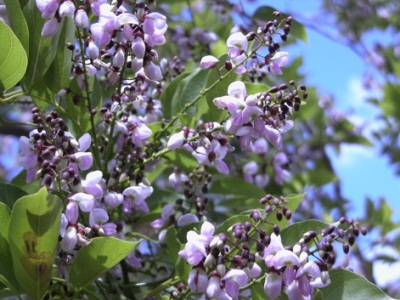
Pongamia is becoming an attractive option for farmers and investors both in Australia and overseas. In the United States plantations are becoming established on failing citrus farms in Florida and in other areas with poor soils and low yields.
In Australia, Pongamia are found in northern tropics and subtropical east coast ranging from the coastal fringe near Darwin, through Cape York and as far south as northern NSW. There are records of Pongamia growing further inland along major rivers including the Archer, Wenlock and Holroyd Rivers in the Cape York area, and the Norman River in the Gulf of Carpentaria. Whether it is a native tree or has been naturalized is a matter for debate, but the tree has existed here for a long time. Aboriginal people used it as a poison for fish spears. It is also found in India and the Asian subcontinent where its natural distribution is along coasts and river banks and is also cultivated along road sides, canal banks and open farm lands.
It is an attractive tree, much utilized by the Brisbane City Council as an ornamental street tree and many mature trees can be observed alongside roadways and in residential neighborhoods.
Pongamia are deep rooted, which allows them to seek out nutrients in deep soil layers. This allows Pongamia to fulfil many of its own needs in infertile, harsh conditions, as well as having the ability to quickly “pioneer” bare or degraded lands. Pioneer plants are nature’s first endeavour to establish vegetation wherever it is lacking.
In addition, Pongamia can be pruned back frequently, and the nutrient-rich leaves used as high-fertility mulch- in turn then supporting many other life forms on the farm.
Pongamia has similarities to most orchard tree crops. It will begin to flower around year from 18 months, though generally flowering occurs from years 3-4, and it becomes commercially harvestable around year 5, with a long productive life of over 50 years and up to 80 years.
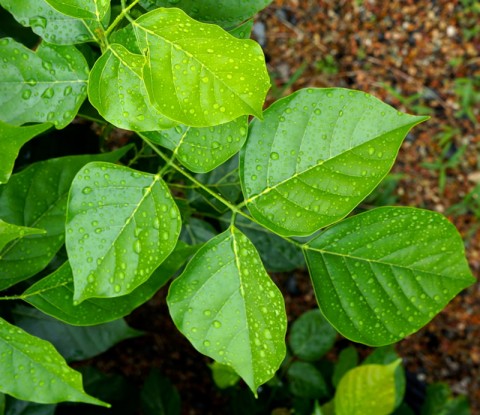
Using sustainable Agroforestry design principles our Pongamia biofuel plantations can be designed to allow inter-row cropping in the first three years. From then on, increasing numbers of livestock can be grazed in and around the plantation due to the improvements in soil biology. Pongamia develops a ten metre tap root which draws nutrients and water from deep in the subsoil layers, in this way contributing to the recycling of important mineral nutrients.
Pongamia’s hardiness allows it to be grown on marginal or unproductive land. When grown on existing crop lands it contributes to the overall food production of the land. It is an excellent tree to rehabilitate degraded sites such as landfill, exhausted farmland and mining sites. it can also be implemented to help to remediate effluent overflows from industry or waste water treatment facilities. Its extensive network of lateral roots work to increase stability in areas that are prone to slippage.
Sustainable Plantations can design small scale intensively managed systems with trees only, or depending on variable factors such as terrain and individual land-holder’s requirements in regards to stock, the system can be modified to more fully realise the potential benefits of Pongamia via improved fertility. A sustainable Agroforestry approach such as this can provide many advantages for landholders and rural communities.
Please note: Pongamia pinnata was recently re-classified with the name Millettia pinnata, and this change has brought about a misconception that Millettia is a higher yielding version of Pongamia. However Millettia is simply a new botanical name, not a new and improved hybrid.
Read more about the benefits of Pongamia for your farm on our Agroforestry page.
Videos